A homeowner searching for an emergency plumber rarely scrolls past the first three map results. Business profile signals alone now account for close to a third of Local Pack rankings, and roughly three in four people who search for a nearby service contact a company within 24 hours of finding it. For plumbers, electricians, roofers, and cleaners competing for that narrow window, Google Business Profile optimization for home service businesses is no longer optional groundwork. It decides who gets the call before a website or a paid ad ever enters the picture. This guide walks through the setup choices, content decisions, and maintenance habits that separate profiles Google trusts from the ones it quietly buries.
How To Optimize Google Business Profile For Home Services

Start with eligibility. Google only issues a profile to businesses that make in-person contact with customers during stated hours, which covers most contractors but rules out lead-generation agencies and online-only estimators. Once eligibility is settled, the business needs an accurate structural classification: a service-area business that travels to clients, a storefront with walk-in traffic, or a hybrid that does both. Getting this wrong is one of the fastest routes to a suspended listing, since Google’s review teams actively audit addresses that do not match the declared model.
Category selection carries the heaviest weight of any single field on the profile. A plumbing company that lists itself under a niche service instead of the general trade weakens its own visibility no matter how many reviews it collects. The primary category should describe what the business is, not what it sells or hopes to rank for.1 Secondary categories can round out sub-specialties, but only when they reflect real, established parts of the operation, not an attempt to capture unrelated searches.
How To Rank Higher On Google Maps For Home Services

Google weighs several factor groups differently depending on whether a search lands in the traditional Local Pack or an AI-generated summary. The table below breaks down where contractors should put their energy first.
| Ranking Factor | Local Pack Weight | AI Search Weight | What Drives It |
| Google Business Profile | 32% | 12% | Category, business name, photos, activity |
| Review Signals | 20% | 16% | Velocity, recency, star rating |
| On-Page Website | 15% | 24% | Schema, city pages, NAP alignment |
| Behavioural Signals | 9% | 10% | Click-to-call volume, direction requests |
| Link Signals | 8% | 13% | Local backlinks, trade partnerships |
| Citation Signals | 6% | 13% | NAP consistency across directories |
Website authority carries noticeably more weight in AI-generated results than it does in the standard map pack, which means a profile alone cannot carry the whole burden. Pairing profile work with a dedicated local SEO push, one that keeps NAP details and schema aligned across the website, tends to move both scores at once instead of just one.
Photos, Descriptions, And Everyday Profile Upkeep
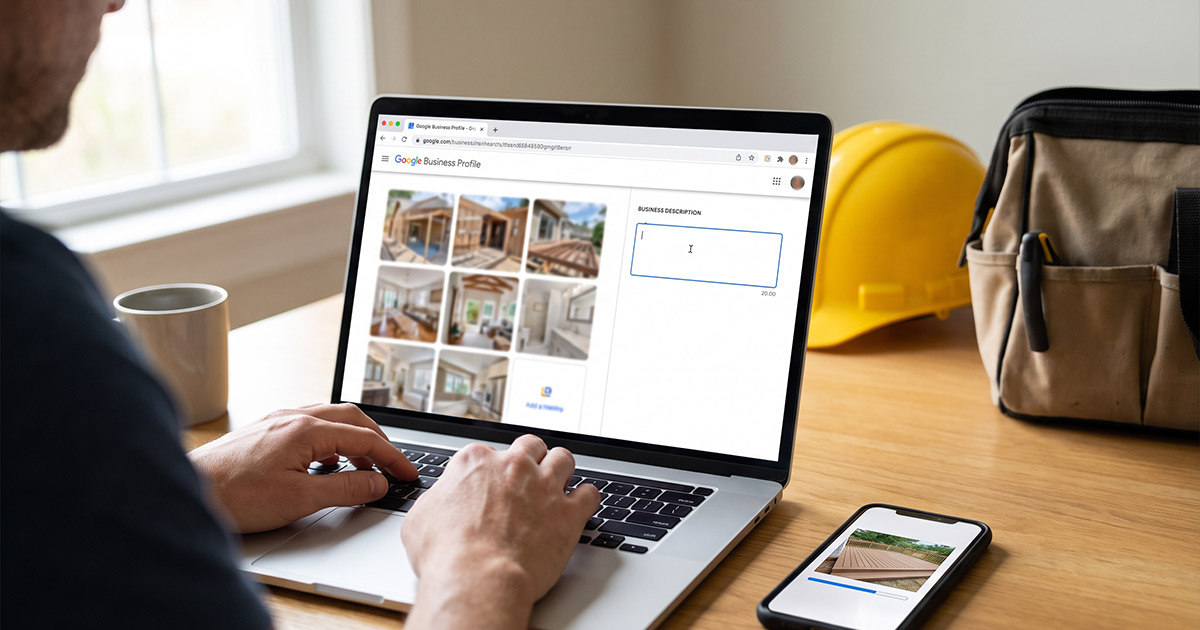
Some of the most reliable Google Business Profile tips for contractors have little to do with algorithms and everything to do with proof. Google’s image recognition can flag stock photography, so real jobsite shots do more for trust scores than any written claim ever could. A handful of additions carry more weight than the rest.
- Branded service vehicles photographed in natural light, with logos and numbers visible.
- Technicians in uniform on active job sites, never posed studio shots.
- Before and after pairs taken from the same angle, free of filters or text overlays.
- Finished installations that show the real quality of the work, not a stock render.
The business description deserves the same care. It has 750 characters to explain history, licensing, and service scope, and Google strips anything that reads like a sales pitch. Phone numbers, discount language, and long strings of city names inside that field tend to trigger quality filters rather than clicks.
Reviews And Reputation Management

Review signals account for roughly a fifth of Local Pack weight, and most people read a business’s responses before ever picking up the phone. A steady trickle of new reviews, five to ten a month rather than a single burst, tends to outperform a large batch collected once and never repeated.
Google’s rules here leave little room. Buying reviews leads to an immediate suspension and the removal of everything already collected. Selectively inviting happy clients while routing complaints elsewhere is barred too. Offering a discount or gift card in exchange for a review is prohibited under FTC guidelines on review manipulation in the United States,2 and Canada’s Competition Bureau enforces a nearly identical rule north of the border, on top of Google’s own policy against it.3
Response habits matter almost as much as the reviews themselves. A short, specific thank you for a positive review, a calm and solution-focused reply to a negative one, and a firm but polite answer to anything that looks fabricated all protect the profile’s credibility without spilling into a public argument. Contractors juggling a slow season sometimes lean on home services PPC to keep the phone ringing while review velocity climbs.
Common Mistakes That Trigger Profile Suspensions

A handful of missteps show up again and again across the contractor space, and any one of them can undo months of careful work.
- Appending city names, slogans, or phone numbers to the business name.
- Displaying a home address without the signage and staff to back it up.
- Running duplicate listings for a single operational location.
- Listing service areas well outside a realistic two-hour drive.
- Claiming 24/7 availability with no live dispatch to answer the calls.
Any of these can trigger an automated flag, a forced name revert, or a full suspension that sends calls straight to competitors. Recovering from one means auditing every non-compliant field, gathering proof of the real business, and filing a formal reinstatement request rather than spinning up a second listing, a move that usually makes the situation worse.
Final Thoughts
Treat this Google Business Profile optimization guide as a maintenance routine rather than a project with a finish line. Categories, hours, and service areas need the occasional review as a company grows, reviews need constant attention, and photos age faster than most owners expect. Contractors who revisit their profile monthly, rather than once a year, tend to hold their map position even as competitors shift tactics around them.
How We Can Help
Wisevu builds and maintains Google Business Profiles for home service companies across Canada and the United States, handling everything from initial verification through ongoing review and photo management. Our team looks after the technical details, schema, categories, service areas, so contractors can stay focused on the jobs already booked. Reach out today to get a quote and see what a properly maintained profile could do for your call volume.
References
- Guidelines for Representing Your Business on Google – Google Business Profile Help. support.google.com/business/answer/3038177?hl=en.
- “The Consumer Reviews and Testimonials Rule: Questions and Answers.” Federal Trade Commission, 1 May 2025, www.ftc.gov/business-guidance/resources/consumer-reviews-testimonials-rule-questions-answers.
- Government of Canada, Innovation, Science and Economic Development Canada, Office of the Deputy Minister, Competition Bureau Canada and Competition Bureau Canada. Misleading Representations and Deceptive Marketing Practices. 1 June 2026, competition-bureau.canada.ca/en/deceptive-marketing-practices/types-deceptive-marketing-practices/misleading-representations-and-deceptive-marketing-practices.
You May Also Like