
A homeowner with a burst pipe searches for a plumber, clicks an ad, and lands on a company history page with six menu tabs. They leave within seconds. Getting the landing page structure for contractors right stops that exit before it happens, because visitors decide whether to stay or leave almost immediately. Research on mobile page speed found that the odds of a visitor bouncing jump by 113% as load time stretches from one second to seven, so a slow, cluttered page can waste an ad budget before anyone reads a single word of copy.1 Contractors who fix this convert far more paid clicks into calls and quote requests, and the fix usually starts with how the page is built rather than with the ad spend behind it.
Why a Dedicated Landing Page Outperforms a Contractor Homepage
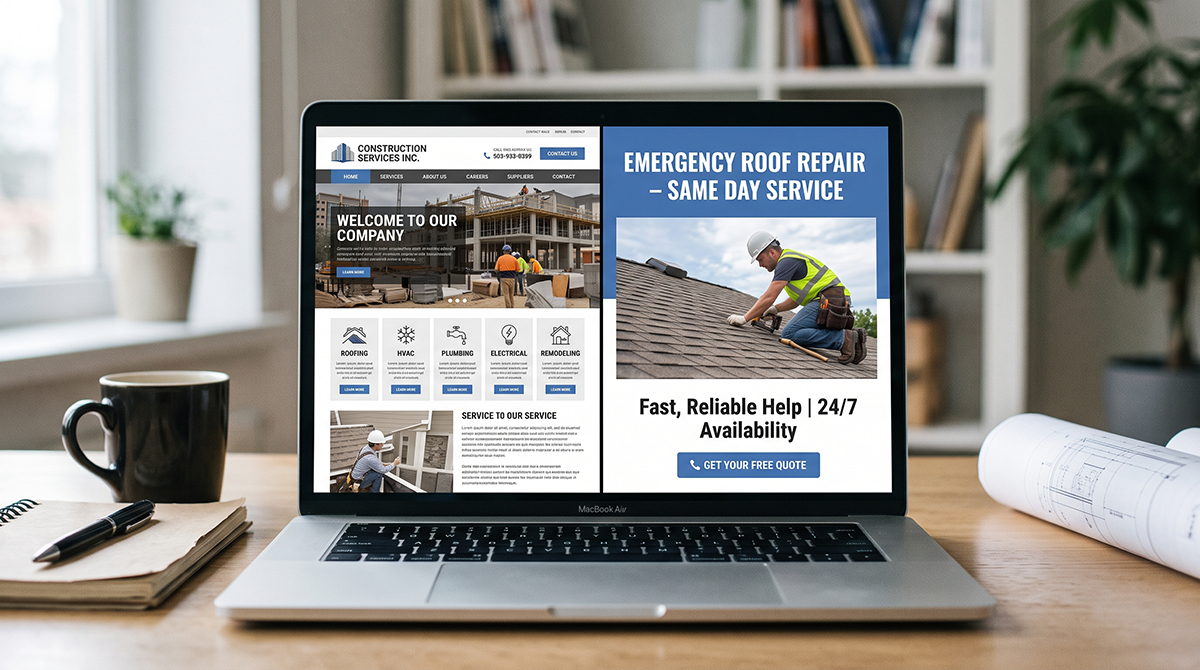
A company homepage serves many people at once: past customers, sub-trades looking for work, suppliers, and new prospects. That mix forces broad navigation and general messaging, which suits brand discovery but works against someone who searched for one job in one city. A dedicated landing page removes the clutter and answers a single question: does this contractor handle my problem, in my area, right now? Whether traffic comes from Google Ads, Local Services Ads, or organic search, a coherent online marketing strategy only pays off when the page matches the promise made in the ad.
How to Build a High-Converting Landing Page for Home Services
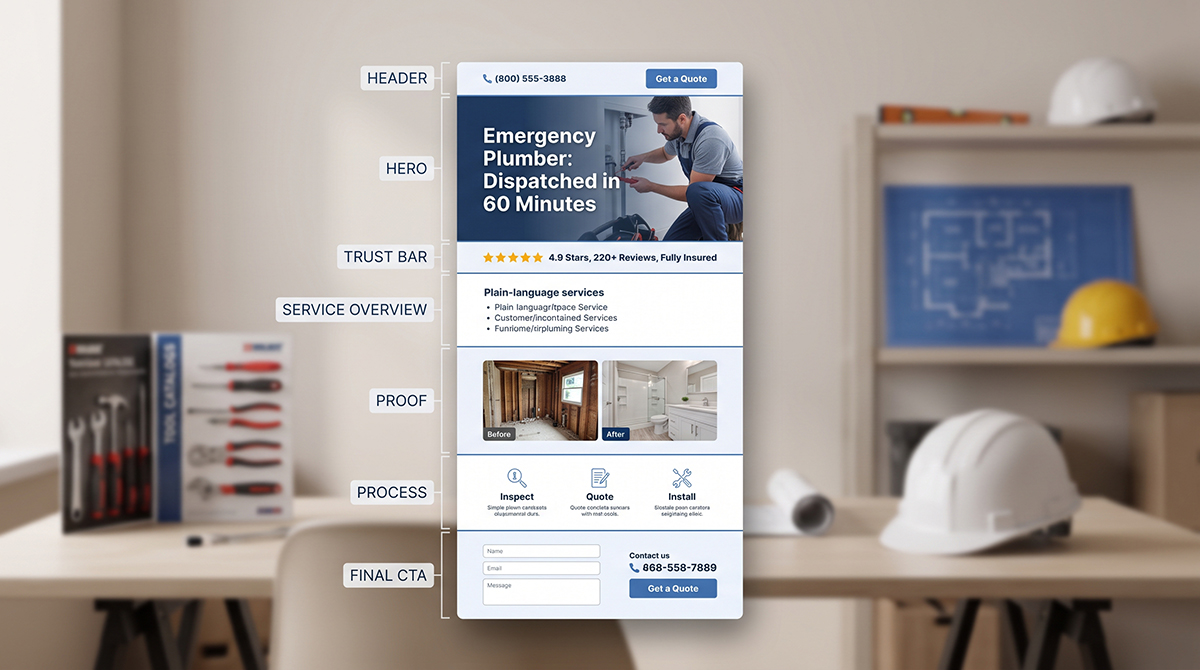
Most effective pages follow a predictable sequence: recognition, trust, then action, without forcing a visitor to search for anything. The table below breaks down the core sections and what each looks like in practice.
| Section | Purpose | Example |
| Header | Click-to-call number, no distracting menu | Logo, phone number, “Get a Quote” button |
| Hero | Confirms trade and city within seconds | “Emergency Plumber in Calgary: Dispatched in 60 Minutes” |
| Trust Bar | Reviews, licensing, insurance | “4.9 Stars, 220+ Reviews, Fully Insured” |
| Service Overview | Scope in plain language | Short bulleted list of inclusions |
| Proof | Real photos and named testimonials | Before-and-after roof photos from a local job |
| Process | Three steps, call to completion | Inspect, quote, install |
| Final CTA | Repeats offer and contact details | Short form plus a clickable phone number |
Nothing on that list is decorative. Each section either builds confidence or moves a visitor one step closer to picking up the phone.
Best Landing Page Design for Contractors

Design choices build trust or raise doubt within the first three seconds, with little middle ground for a homeowner staring at a cracked foundation or a dead furnace. A generic headline like “Ottawa’s Leading Quality Roofing Team” tells a visitor nothing about whether the company works in their neighbourhood. Swap it for “Roof Replacement in Ottawa: Free On-Site Estimates,” and the same visitor knows within a glance that they are in the right place. The same logic applies to photography: stock images of models holding tools read as generic, while a photo of a branded truck outside a real job site builds more confidence than another paragraph of copy ever could.
Landing Page Best Practices for Home Service Companies

A handful of practices separate pages that convert from pages that just sit there collecting traffic.
- Display the licence number in the header or footer rather than burying it in fine print. In the United States, California’s licensing board actively encourages homeowners to verify a contractor’s licence before signing anything, so a visible number removes friction instead of creating it.
- Place a Google review score and count near the primary call to action, since third-party validation carries more weight than a company’s own claims.
- Format every phone number as a clickable link so a mobile visitor can call with a single tap rather than copying a string of digits.
- State the exact service area by city or neighbourhood instead of a vague line about serving the whole region. It cuts down on unqualified leads from outside the territory.
Common Mistakes That Cost Contractors Leads
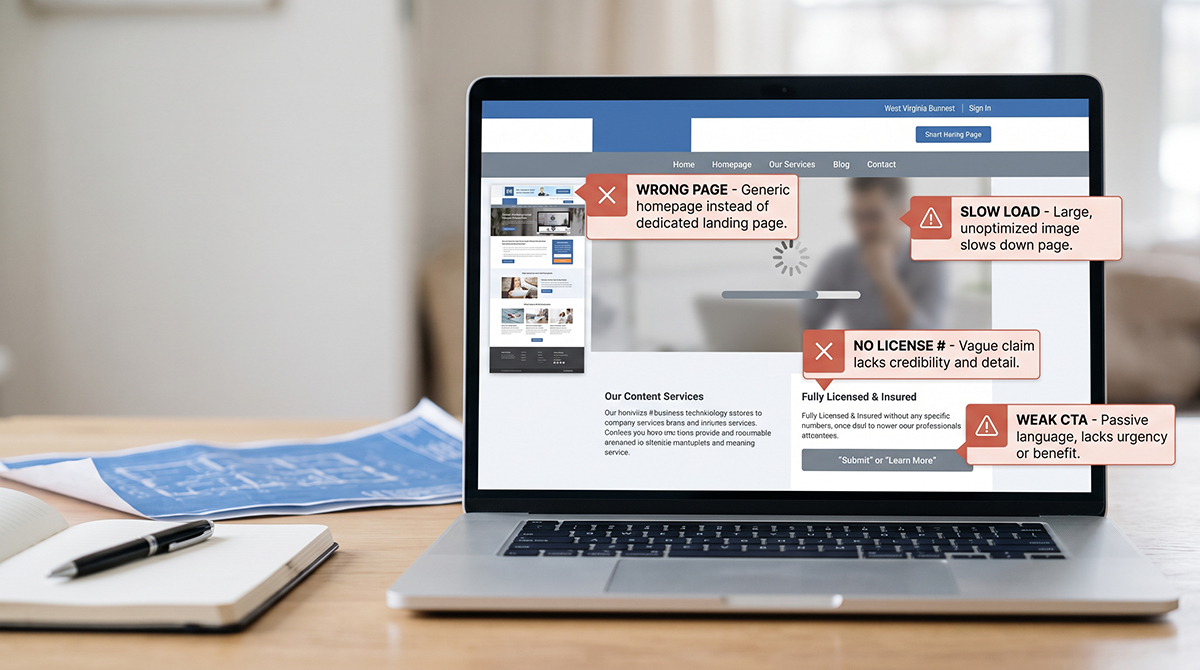
These contractor website landing page tips only work once a few common errors are ruled out first.
- Sending every ad click to the homepage instead of a page built for the exact service searched, which forces visitors to hunt through menus for what they came to find.
- Uploading full-size camera photos that push mobile load times past several seconds, a problem that is usually a web design and development fix rather than a copywriting one.
- Leaving licensing claims vague, such as “fully licensed and insured” with no number attached. In Ontario, most trades require a Certificate of Qualification before anyone can legally perform the work, a standard set by the province’s skilled trades regulator, and a page that skips the number leaves the claim unverified.
- Using a passive label like “Submit” or “Learn More” on the main button, giving visitors no real reason to click right now.
Final Thoughts

None of this is a one-time project. Landing page optimization for home service businesses works best as an ongoing habit, testing one variable, such as a headline, a photo, or a button label, at a time rather than changing everything at once and losing track of what moved the needle. A contractor who treats the page as a living tool, checked against real call volume and lead quality every few months, ends up with a far stronger asset than one who builds it once and walks away.
How We Can Help
Our team at Wisevu builds and refines landing pages for plumbers, roofers, HVAC companies, and other home service trades across North America, pairing trade-specific copy with the technical performance Google rewards. We handle the licensing details, the photography, the mobile speed fixes, and the ongoing testing, so a contractor’s marketing budget goes toward calls instead of bounced clicks.
Get a quote from our team today and start turning more of your paid traffic into booked jobs.
References
- Convert & Retain: Turn leads into booked Revenue · Insights · Dean Garland. (n.d.). Dean Garland.
- California, S. O. (n.d.). How do I find the right licensed contractor? – CSLB. https://www.cslb.ca.gov/consumers/hire_a_contractor/finding_the_right_contractor.aspx
You May Also Like