Every day, homeowners in your service area search for exactly what you offer — and see ads, map listings, AI-generated answers, and competitors before they ever find you. Two channels decide who wins those customers: Search Engine Optimization (SEO) and Pay-Per-Click (PPC) advertising.
In this blog, we’ll break down Google Ads vs SEO for home services, compare how each one works, and look at which option can bring in leads more efficiently over time.
SEO vs PPC for Home Service Businesses: Which Is Better for Your Marketing Budget?
Your marketing budget has one job: to ensure your lead generation home services marketing. Meaning: qualified leads that turn into booked work. Both channels can do that, but they differ in cost per lead, lead quality, speed, and long-term value — and that’s how we’ll compare them.
What you get from us
SEO
- Keyword research: We find every question your potential customers are asking, so we know exactly what to rank you for.
- Content writing: We write the pages and articles that answer those questions, so when someone searches, you show up as their best option.
- Local SEO: We optimize your site and Google Business Profile for the neighborhoods you actually serve, so your leads come from your service area, not another city or country.
- AI search (GEO): We make sure that when people ask ChatGPT, Gemini, or Google’s AI “who should I hire?”, your business is the answer they get.
- Technical SEO: We keep your website fast, secure, and easy for Google to read, so nothing holds your rankings back.
- Link building: We get trusted websites to point to yours, so Google sees you as the authority in your market.
- Review management: We help you collect and manage Google reviews, so customers choosing between you and a competitor pick you.
PPC
- Google Ads: We work to put you at the top of the page the moment someone searches for your service, targeting only the zip codes and customers worth paying for.
- Meta (Facebook & Instagram) ads: We put your work in front of local homeowners before they even start searching.
- Remarketing: We bring back visitors who checked out your site but didn’t call, so you get a second chance at every lead.
- Landing pages: We build the pages your ads send people to, designed for one thing, turning clicks into calls and quote requests.
- Call & lead tracking: We track every call and form submission back to the ad or page it came from, so you always know exactly what your money is doing.
How SEO and PPC Use Your Budget Differently
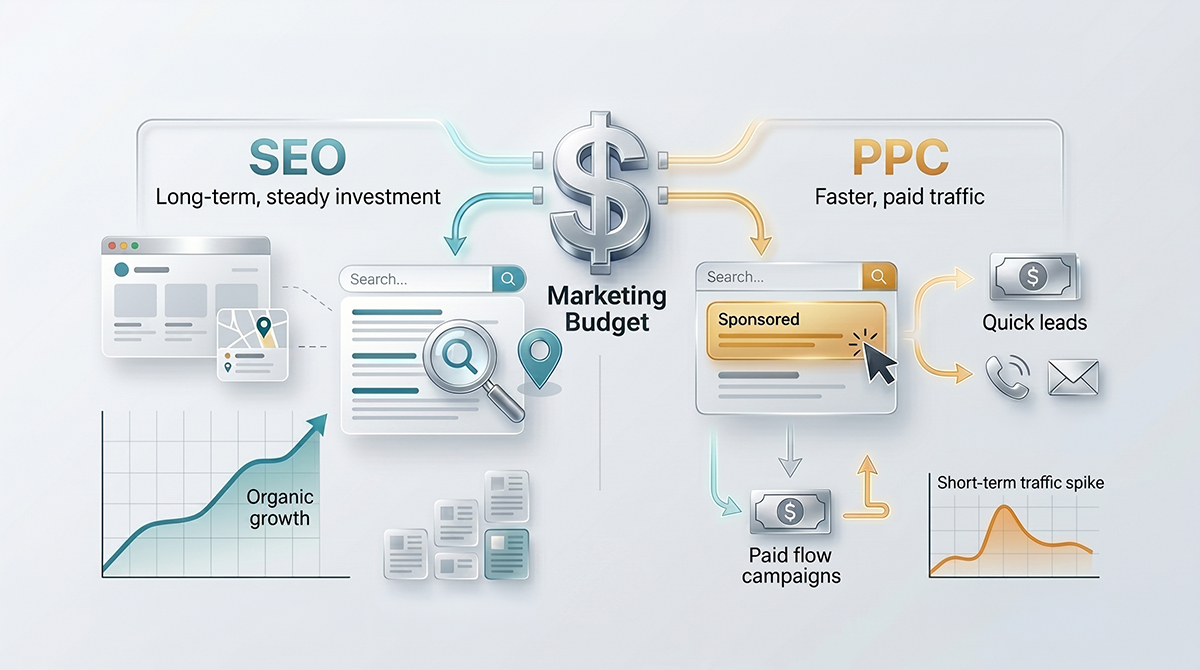
SEO for home service companies goes far beyond tweaking a few pages. A complete program includes technical SEO (site speed, crawlability, Core Web Vitals), keyword research, conversion-optimized service and location pages, SEO content writing, local SEO and Google Business Profile optimization, review and reputation management, link building, and analytics that track which searches actually turn into calls and booked jobs.
It also now extends beyond Google. With more homeowners asking ChatGPT, Gemini, and Google’s AI Overviews for recommendations, Generative Engine Optimization (GEO): building the content and authority signals that get your business cited by AI-powered search, has become part of any serious SEO strategy.
Google’s SEO guidance explains that search engines need to be able to crawl, index, and understand your content 1, while a complete and accurate Google Business Profile can help support local visibility. Unlike PPC, you are not paying for every click, but SEO does take time to build momentum and start producing consistent leads.
With PPC, you are paying to show up in search results when potential customers are already looking for a service like yours. This can help you bring in traffic and leads faster than SEO, especially in competitive local markets. Your budget goes toward the ad campaign itself, including keyword targeting, clicks, landing pages, and management.
Paid advertising is also broader than Google Search ads alone. Depending on your market, a paid program can include Local Services Ads, display and remarketing campaigns that re-engage past visitors, and Meta (Facebook and Instagram) ads that build demand before homeowners ever search.
What makes any of it pay off is the same: tight targeting, conversion-optimized landing pages, and call and form tracking.
However, PPC depends on more than simply bidding on the right keywords. For the best results, your campaigns should reflect how your business operates, including your services, locations, revenue goals, and customer intent.2
PPC can also generate traffic quickly, but it can lead to wasted ad spend if those clicks are not turning into calls, form submissions, or booked jobs.
PPC vs SEO Cost Comparison: What Real Client Data Reveals
For home service businesses, the best marketing channel is not always the one that sends the most visitors to your website. It is the one that brings in qualified inquiries at a cost you can sustain. PPC and SEO can both drive valuable inquiries, but they affect your budget in very different ways.
At Homevu, we track how each channel contributes to real inquiries, including phone calls and form submissions. The table below compares PPC and organic SEO cost per conversion across five home service client categories: contractor, interior design, pest control, specialty cleaning, and automotive.
| Contractor Client | Interior Design Client | Pest Control Client | Specialty Cleaning Client | Automotive Client | |
| Cost Per Conversion – Google Ads | $77 CAD | $57 CAD | $45 CAD | $50 CAD | $18.59 CAD |
| Average Cost Per Click | $10 CAD | $7.50 CAD | $6.50 CAD | $6 CAD | $4.79 CAD |
| Cost Per Conversion – Organic SEO | $25 CAD | $20 CAD | $16 CAD | $18 CAD | $7.35 CAD |
| Google Ads vs SEO | Leads from Google Ads are 3x more expensive than SEO leads | Leads from Google Ads are 2.8x more expensive than SEO leads | Leads from Google Ads are 2.8x more expensive than SEO leads | Leads from Google Ads are 2.8x more expensive than SEO leads | Leads from Google Ads are 2.5x more expensive than SEO leads |
The table gives a practical Google Ads vs organic traffic comparison across several home service client categories. It shows a consistent pattern: SEO conversions cost less than Google Ads conversions for every client category included. That cost gap matters because it affects how far your marketing budget can go.
The contractor client is a good example. A Google Ads conversion costs $77 CAD, while an SEO conversion costs $25 CAD. That is a $52 difference per lead. Over time, that difference can add up and change how much a business needs to spend to generate the same number of inquiries.
The takeaway is not that PPC should be avoided. PPC can be useful when you need leads quickly, want to test a new service, or need visibility in a competitive market. But because the cost per conversion is higher in this data, PPC needs strong targeting, clear landing pages, reliable tracking, and fast follow-up to make sense.
SEO usually takes longer to build, but the lower conversion costs shown here suggest it can become a more efficient lead source over time. For many home service businesses, the best approach is to use PPC when immediate visibility matters, while building SEO to reduce long-term reliance on paid clicks.
How to Decide Where to Spend Your Marketing Budget
Before putting more money into SEO or PPC, think about what your business needs most at its current stage. A business trying to get its first calls has different needs than one trying to scale across multiple service areas. The goal is to match your budget to your current stage, so you are not overspending on fast traffic when you need long-term growth, or waiting on SEO when you need leads now.
New Business
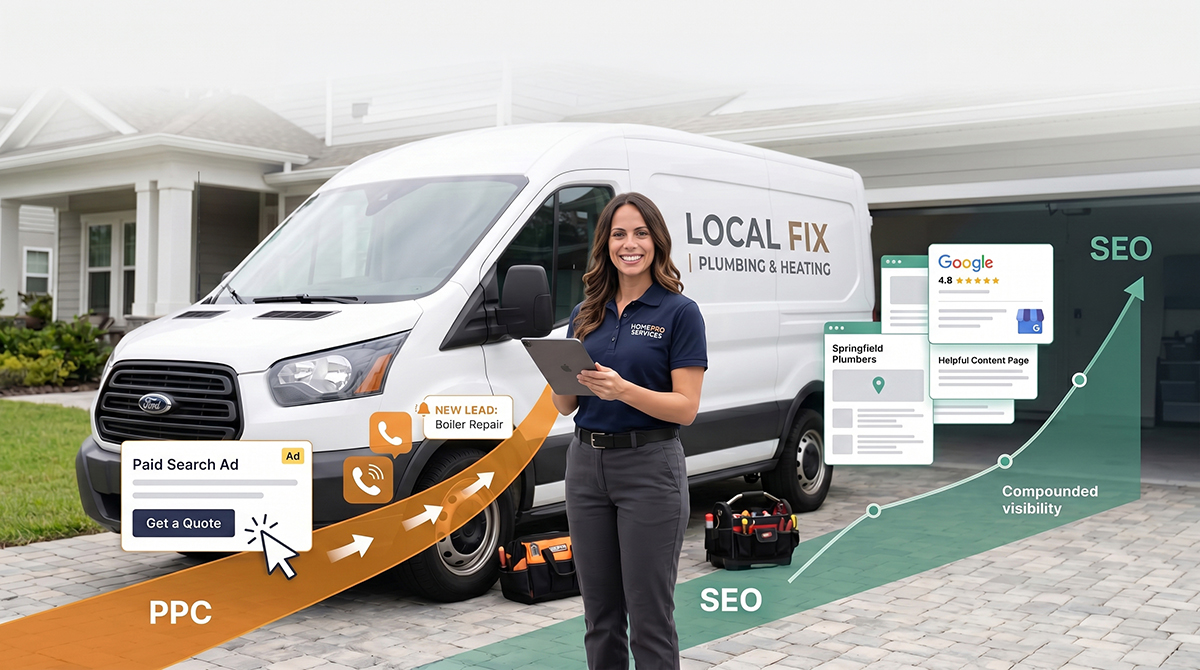
If your home service business is new, PPC can help you get in front of potential customers while your organic presence is still building. You may not have strong rankings yet, and customers may not recognize your brand, so paid search can give you a faster way to generate calls, quote requests, and website visits.
That said, PPC should not be your only plan. If you wait too long to invest in SEO, you may stay dependent on paid ads for every lead. Starting SEO early helps you build the foundation for long-term visibility through service pages, location pages, local SEO, reviews, and helpful content.
Growing Business
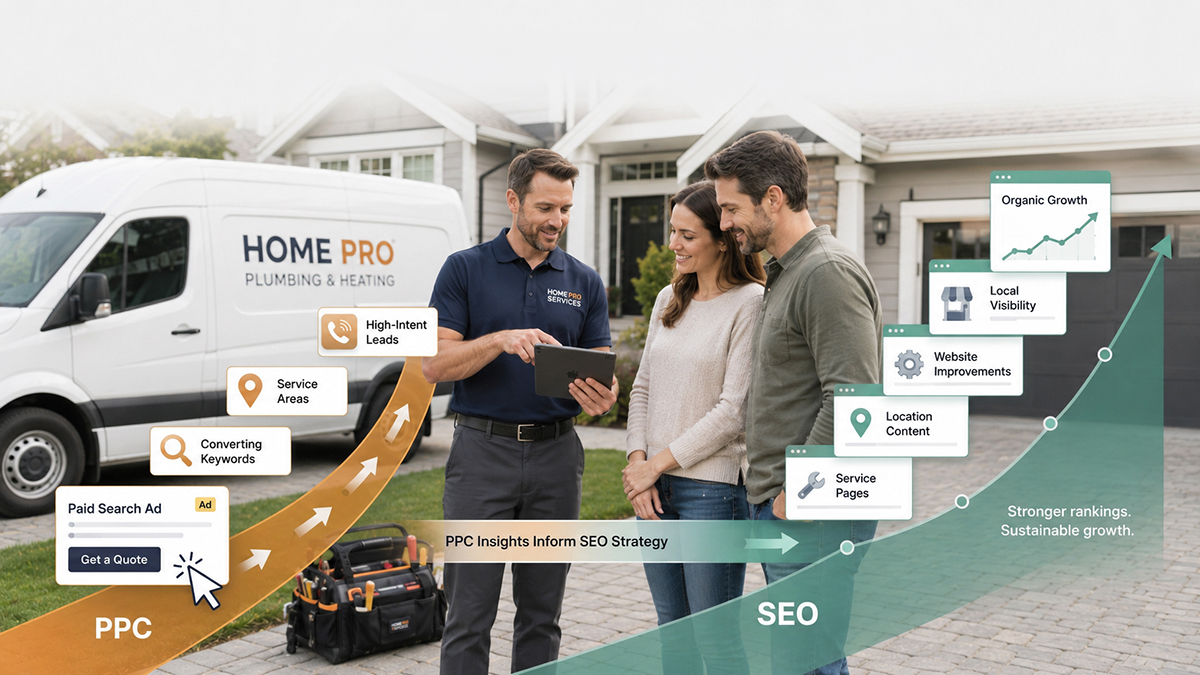
For a growing home service business, the priority is not simply getting more leads. It is knowing which leads are worth scaling. At this stage, your marketing budget should be guided by performance data: which services bring in the best jobs, which locations convert well, and which search terms are producing serious inquiries.
This is where SEO and PPC can work together more strategically. PPC data can reveal which keywords, offers, and service areas are already converting. That information can help guide future SEO pages, location content, and website improvements.
Established Business
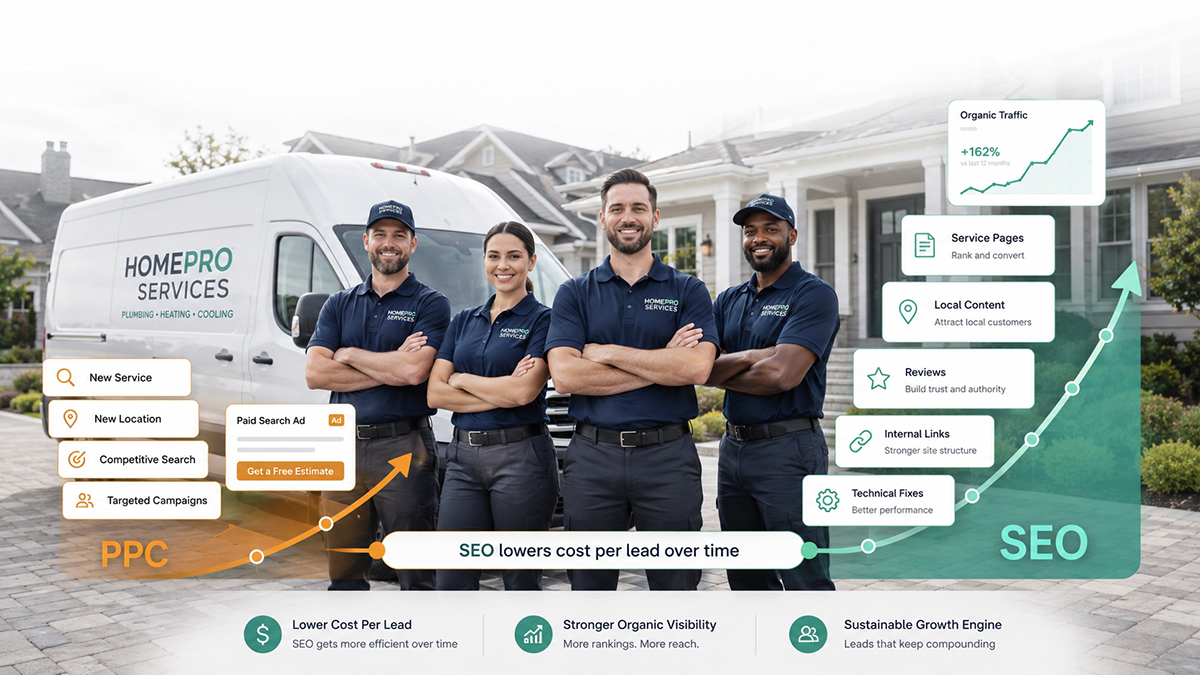
At the established stage, the question is less about how to get any leads and more about how to get leads efficiently. If your business already has steady demand, SEO can help lower your average cost per lead by capturing more organic searches over time.
That increasingly includes AI-driven search: the businesses investing in SEO and GEO now are the ones ChatGPT, Gemini, and AI Overviews will recommend when homeowners ask.
Improving service pages, adding stronger local content, building reviews, tightening internal links, and fixing technical issues can all help your website bring in more organic traffic. PPC can still play a role, but it should be used more intentionally. For example, it may make sense for a new service, a new location, or a competitive search where your organic rankings still need time to improve.
Final Takeaways
More traffic does not always mean better marketing. For home service businesses, the real measure of success is whether your marketing brings in qualified inquiries at a cost your business can sustain. That is why comparing SEO and PPC by cost per conversion gives a clearer picture than looking at clicks or impressions alone.
At Homevu, we help home service companies turn search visibility into real business opportunities.. Our team connects SEO, AI search optimization (GEO), Google Ads, Meta advertising, conversion-focused web design and landing pages, review management, and full call and form tracking into one strategy, so you are not just getting more visitors, but better leads at a lower cost per lead. Ready to turn more searches into booked jobs? Get a free proposal today.
References:
- Google. “SEO Starter Guide: The Basics.” Google Search Central, Google for Developers, https://developers.google.com/search/docs/fundamentals/seo-starter-guide. Accessed 12 May 2026.
- Osmundson, Brooke. “Why Your PPC Structure Should Mirror Your Business Model.” Search Engine Journal, 4 Aug. 2025, https://www.searchenginejournal.com/why-your-ppc-structure-should-mirror-your-business-model/550986/. Accessed 12 May 2026.
You May Also Like