The Myth of “Easy” Local Rankings
It’s 9pm on a Friday, and a homeowner’s air conditioner just died in the middle of a heat wave. They grab their phone and search for “AC repair near me.” Three companies show up. Yours isn’t one of them, even though your nearest crew is five minutes from that address and your Google rating is a full point higher than the company that got the call instead. That’s right, Local SEO for contractors is not enough to get you more customers.
That’s not bad luck. It’s how the algorithm actually works, and it trips up a lot of well-run companies for a simple reason: it’s genuinely logical to assume that being close and well-reviewed should be enough. Homeowners search “near me” because location matters to them. Reviews are what make them comfortable enough to book. Neither assumption is wrong, they’re just incomplete.
Proximity gets you into the conversation; it doesn’t win it. Reviews convert a homeowner who’s already found you; they don’t determine whether Google surfaces you in the first place. The businesses that consistently hold the top three spots have something else going on behind the scenes: a website and citation footprint strong enough to earn Google’s confidence, and a digital presence complete enough that AI search tools are willing to vouch for them by name.
A company running its Google Business Profile in isolation, disconnected from everything else that builds trust online, will eventually stall out no matter how many five-star reviews it collects.
The Google Pigeon Paradigm Shift
When the Map and the Web Search Became One Algorithm
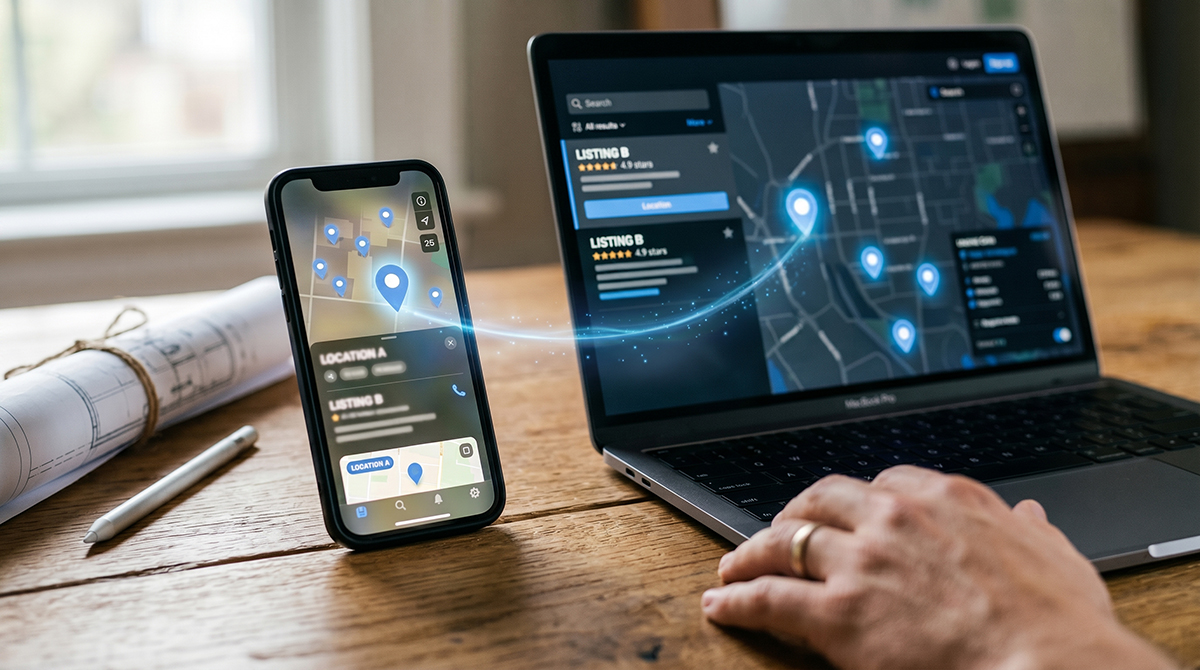
Home service companies used to be able to plant a flag in local results with a fairly bare listing: accurate hours, the right trade category, a service radius set in the dashboard, and get real visibility from that alone. Local rankings ran almost independently of how strong (or weak) the company’s actual website was.
Google’s July 2014 Pigeon update ended that separation for good. Pigeon merged the algorithm powering the Map Pack with the one powering standard organic search, so a contractor’s website strength and its local ranking became a single, connected system rather than two unrelated scores. The visible consequence: local results that used to list seven to ten businesses per search collapsed down to today’s 3-pack, which means fewer available slots and sharper competition for every emergency, seasonal, and “near me” query in your trade.
Why Service-Area Strength Beats a Bare Listing

Since Pigeon, a home service company’s Domain Authority, backlink profile, and on-page technical SEO directly determine where its listing lands on the map, not just where its site ranks organically. Google weighs three pillars for local results:
- Relevance: how precisely your content matches the request (a page built for “24/7 emergency water heater repair” beats a generic “plumbing services” page every time)
- Distance: proximity to the searcher, or to the service area implied by the query
- Prominence: how authoritative and well-corroborated your business is across the web
Distance is fixed, your trucks are where they are, and multi-location or wide-radius companies especially can’t out-drive it.
Relevance and Prominence are the levers you actually control, and for home services they run through some specific, trade-relevant proof points: license numbers that check out against public license-lookup data, insurance and bonding claims that are corroborated rather than just stated, and manufacturer or trade certifications (a “Factory-Authorized Trane Dealer” badge, for instance) that carry real weight because they’re independently verifiable.
| What Most Contractors Track | What Actually Shapes Map Pack Rank |
|---|---|
| Star rating and review volume | Domain Authority and backlink quality from trade and industry sources |
| Service radius set inside the GBP dashboard | Unique, indexable service-area landing pages for each city or neighborhood served |
| A listing on Yelp, Angi, or HomeAdvisor alone | Citation consistency (license number, hours, service area) across the entire directory landscape, plus manufacturer/certification pages |
| One generic homepage covering every service | Trade- and intent-specific pages, e.g. “24/7 Emergency Water Heater Repair in [City]” |
Takeaway: A polished GBP without a matching website and citation network behind it will hit a ceiling. You can have the better rating and still lose the call to a competitor whose broader digital footprint simply carries more weight with Google’s algorithm.
The New Frontier: AI Search & LLM Optimization (GEO)
Pigeon reshaped how Google itself ranks local businesses. The next disruption is already here: homeowners are increasingly asking AI tools like Claude, ChatGPT, Perplexity, Gemini, Google’s AI Overviews instead of scanning a results page.
How an AI Assistant Actually Picks a Contractor

Ask an AI system “Who is the most reliable emergency plumber in [City] with fast response times?” and it isn’t pulling up a map pin. It’s pulling together an answer from the sources it currently trusts most: your website, your GBP, review platforms, trade directories, and anywhere else your business is documented; and naming the one(s) that hold up under cross-checking.
Entity Trust Replaces the Star Rating

This is what Generative Engine Optimization (GEO) is really about: AI models don’t stop at your rating. They evaluate Entity Authority: can this business be independently verified as licensed, insured, and legitimately established?
That means checking whether your business name, address, phone number, and license number match everywhere you’re listed, whether your site carries structured data that spells out your trades and service areas, and whether independent sources (trade associations, manufacturer directories, the Better Business Bureau, local press) back up the claims your own site makes.
A “licensed and insured” tagline that doesn’t match public license records anywhere else doesn’t just fail to help; it can actively erode how confidently an AI system recommends you.
Don’t Be a One-Channel Business

A company that exists only as a GBP listing and a thin homepage reads to an AI model as a shallow, unverifiable entity. A company with real service-area content, trade certifications on display, consistent citations, and mentions in local press or community coverage reads as a deep, corroborated one, the kind AI tools are comfortable naming outright when a homeowner asks a specific, urgent question. That’s the difference between showing up in an AI-generated answer and being the answer.
Our Agency Solution: The Full-Stack Top 3 Growth Framework

This is exactly the gap Homevu was built to close. We treat GBP management as one piece of a larger marketing system, because that’s the only way the algorithm, or an AI model, actually evaluates you.
Quick-Win Keyword Targeting. We start with the fast-opportunity terms specific to your trades: emergency and same-day intent, seasonal spikes, city-plus-service combinations, that are realistically within reach of a top-3 position with focused, targeted adjustments, so you get measurable movement before a broader campaign fully kicks in.
Comprehensive SEO Execution. From there, we build the Prominence signals Pigeon made non-negotiable: unique service-area landing pages for every city and neighborhood you cover, technical SEO health, LocalBusiness and service-specific schema markup, and a link-building program that earns citations from trade associations, manufacturer directories, and other sources that genuinely carry weight in your industry.
Homevu deploys the full depth of our content, digital PR, technical, and off-site capabilities at peak scale to establish your brand as the undisputed leader across traditional search, AI-generated results, and every channel that drives qualified lead growth.
Hands-On Review Engine & Training. Reviews still matter, not as the whole equation, but as a real Prominence signal and the thing that turns a phone call into a booked job. Our proprietary review automation platform pairs with hands-on training for dispatchers and field crews, so review requests go out consistently right after every completed job, instead of getting forgotten in the rush to the next call.
AI Engine Optimization. Finally, we structure your license, certification, and service-area data so both traditional ranking algorithms and generative AI models can verify and confidently recommend your business, delivering AI visibility where it matters, and positioning you for how homeowners are increasingly finding a contractor today.
A well-kept GBP and a stack of reviews were never the whole strategy, they’re the visible surface of a system Google has spent over a decade tying directly to your website’s strength, and one that AI search is now scrutinizing even further through license verification, citation consistency, and independent corroboration.
Contractors who keep managing their listing in isolation will keep losing top-3 positions and the calls that come with them to competitors whose entire digital footprint earns more trust.
Book a Local & AI Search Audit with Homevu, and we’ll show you exactly where your Relevance, Prominence, and AI visibility stand today, along with the prioritized roadmap to move your business into the top 3.
You May Also Like